
What Does "Non-toxic" Actually Mean at a Nail Salon?
A guide for anyone who's wondered what's actually in that bottle and why it matters
If you've searched for a non-toxic nail salon in Brooklyn, you've already done something most people haven't: you've asked a question. But what does the phrase actually mean once you're sitting in the chair?
The beauty industry loves a wellness-adjacent term. "Clean," "natural," and "non-toxic" appear on product labels and salon signage with no standardized definition behind them. So let's break it down plainly — what the concerning ingredients are, why they ended up in nail products in the first place, and what a salon committed to non-toxic practices actually does differently.
The chemicals worth knowing
Conventional nail polish and nail treatments can contain a cocktail of synthetic chemicals — many of which were introduced decades ago for performance reasons, before their health implications were well understood. The most commonly referenced ones include:
Formaldehyde: A known carcinogen used as a nail hardener. Also found in some nail polishes as a preservative.
Toluene: A solvent that helps polish apply smoothly. Linked to neurological effects with repeated exposure.
Dibutyl phthalate (DBP): A plasticizer that prevents chipping. A known endocrine disruptor.
Formaldehyde resin: A derivative used for adhesion — distinct from formaldehyde itself, but still worth avoiding.
Camphor: Gives polish its glossy appearance but can cause nausea and dizziness with prolonged inhalation.
Triphenyl phosphate (TPHP): A plasticizer and potential endocrine disruptor — found in many mainstream polish formulas.
This is why you'll see polish brands labeled "3-free," "5-free," "10-free," and beyond — those numbers refer to how many of these ingredients have been removed from the formula. The higher the number, the cleaner the formula.
Why does it matter more at a nail salon than at home?
The difference is exposure. If you paint your nails at home once a week, you're dealing with a brief, low-level encounter. Nail technicians work with these products every day, for hours at a time — and so do clients who visit frequently. Ventilation, product selection, and the overall commitment of the salon to clean ingredients all compound over time.
The nail salon industry has historically faced documented concerns around worker health — respiratory issues, skin conditions, and hormonal disruption among the most commonly cited. Choosing a non-toxic salon isn't a niche preference. It's a reasonable response to real, established risk.
What "non-toxic" looks like in practice
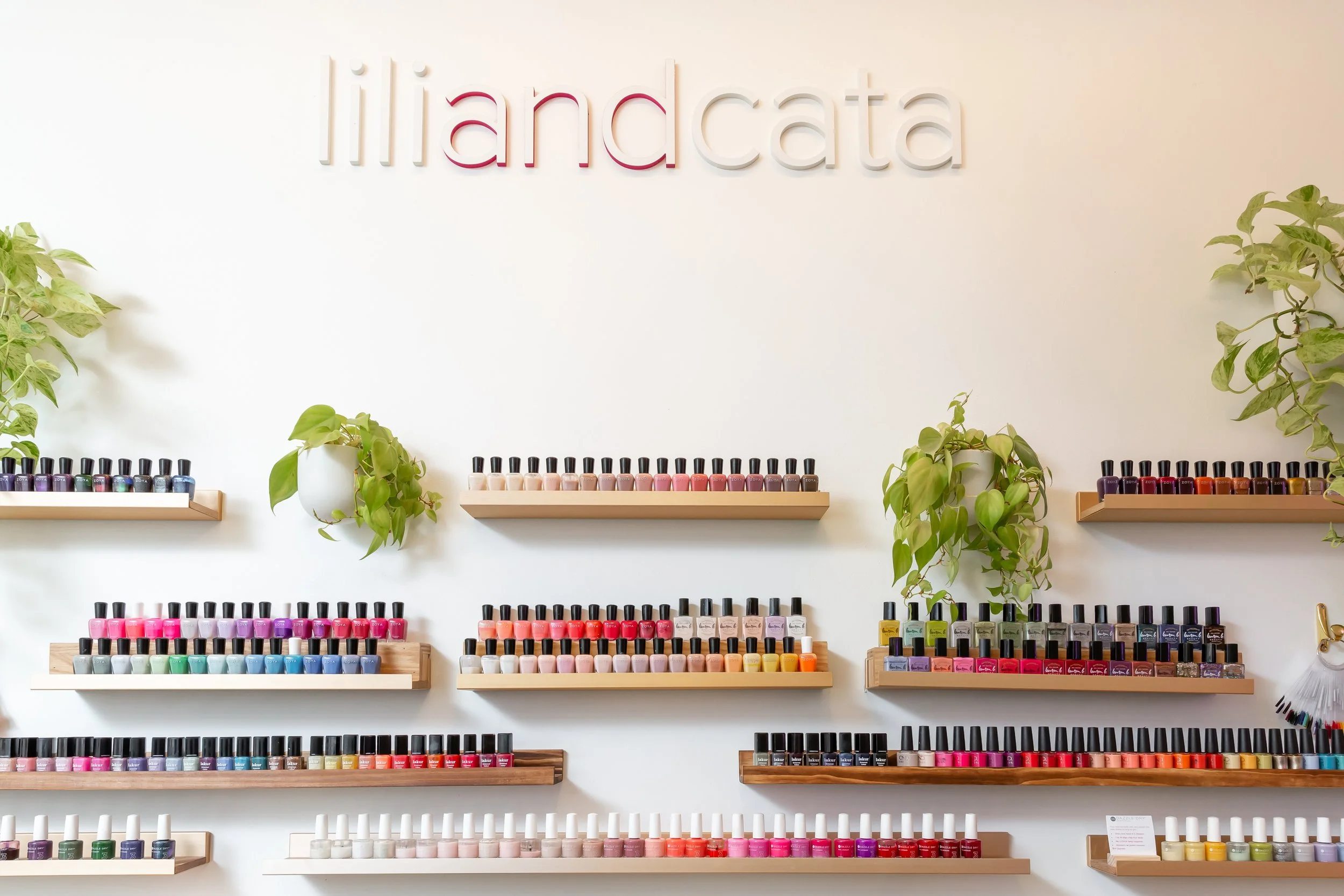
A genuinely non-toxic salon will be specific about the brands it uses and the formulas behind them. At liliandcata, we've made deliberate choices about every product on our shelves — sourcing nail polishes from brands like Zoya, whose Big 10 Free formula excludes ten of the most harmful ingredients, and curating our full service menu around the same principle.
"Non-toxic" isn't a certification or a regulated label. It's a commitment — one that has to be backed up by actual ingredient choices, not just marketing language.”
—Lilly Rojas, Co-founder, liliandcata
It also means asking good questions of the brands we work with, staying current on ingredient research, and being transparent with clients who want to know exactly what's going into their treatments. You should always be able to ask your salon what's in the products they use. If they can't answer, that's information too.
Non-toxic nail care isn't about perfection — formulas are always evolving, and "free-from" labeling can only go so far. But it is about intentionality: the choice to prioritize cleaner ingredients over convenience, and to build a salon environment where both clients and technicians can feel good about what they're working with.
If you're looking for a non-toxic nail salon in Brooklyn, we'd love to show you what that commitment looks like in practice. Book an appointment at our Greenpoint or Williamsburg location — and don't hesitate to ask us anything.