
Soft Gel vs. Rubber Gel vs. Builder Gel (Hard Gel)
What's Actually the Difference?
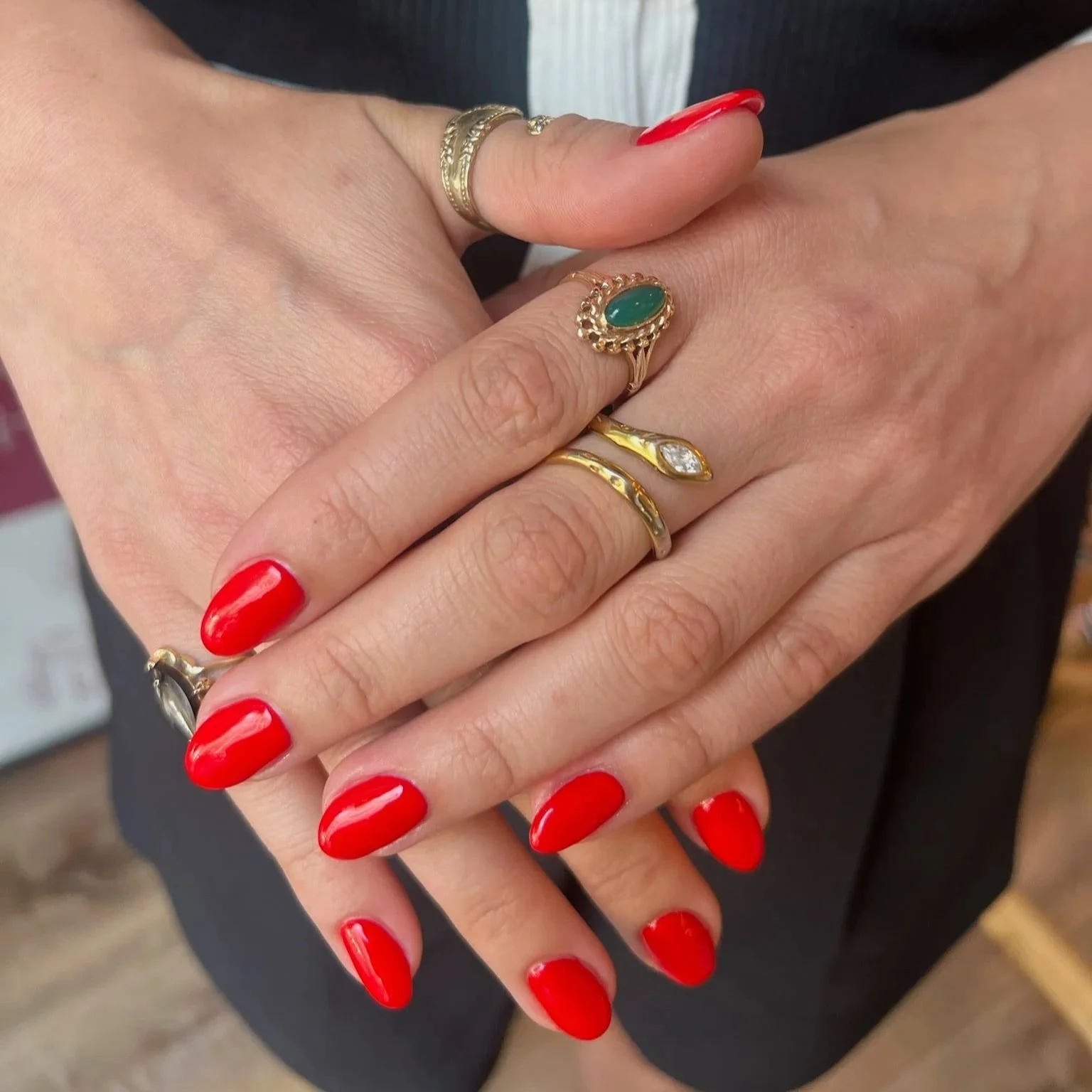
The Short Answer
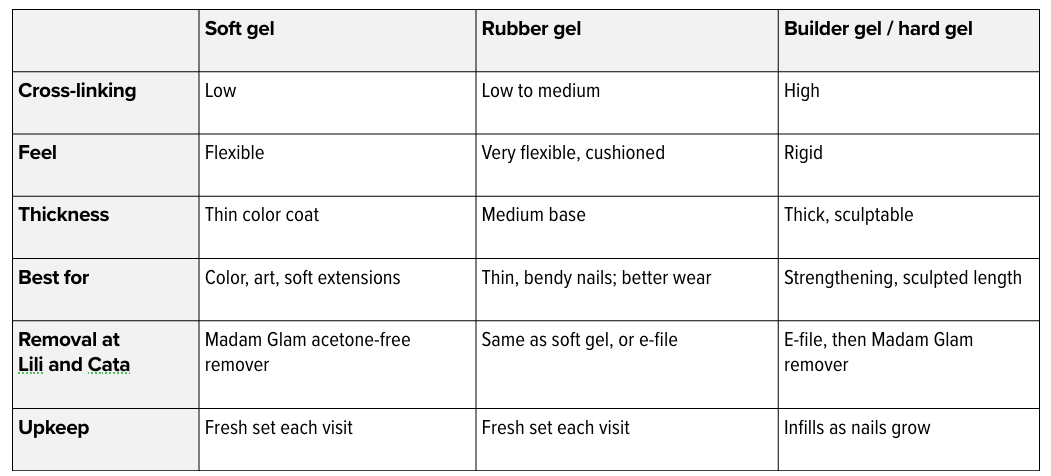
Soft gel, rubber gel and builder gel are all light-cured gels: liquid acrylates that harden under a UV or LED lamp. (Builder gel is also called hard gel; most nail pros, us included, use the names interchangeably.) What separates them is cross-linking, or how tightly the molecules lock together once cured.
Soft gel (gel polish and soft gel extensions) is the color layer. It's flexible and glossy.
Rubber gel (rubber base) is a thicker, bendy base that cushions thin or soft nails and helps a manicure stay put.
Builder gel, a.k.a. hard gel, has the tightest network. It's thick, rigid and strong, made to reinforce and sculpt, and it's filed off rather than dissolved.
Think silk, neoprene and armor. Same fiber, very different weave.
Why cross-linking is the whole story
Once cured, gel forms a polymer network. Soft gels use a less densely cross-linked network, porous enough for soak-off solution to get in and release it (Akzentz). Hard gels are cross-linked so tightly they're non-porous, so solvents can't break them down, which is also where their strength comes from (Akzentz).
Rubber gel uses softer oligomers and fewer cross-links than builder gel, so it cures into a bendy, resilient coating (Nail Knowledge). Builder gels span a range of densities, with denser ones behaving like classic hard gel, which is why salons use those two names interchangeably. The rule: more cross-linking means more strength, less flex and a harder removal.
Soft gel: the everyday glaze
Best for: color, nail art and weeks of chip-free shine. Soft gel also includes soft gel extensions (Gel-X style): full pre-shaped tips adhered with soft gel, so you get length without sculpting.
Removal: no acetone soak, no foils. We buff the top coat, apply Madam Glam Gel Polish Remover, let it sit about 10 minutes, then lift the softened gel with a cuticle pusher.
Know this: it's a coating, not a structure. Thin, bendy nails can still break underneath.
Rubber gel: the flexible foundation
Rubber gel, often sold as rubber base, sits under your color. It's thicker than a regular base coat but thinner than builder gel, self-levels to smooth out ridges, and bends with the nail instead of fighting it (Gelous).
Best for: thin, soft and short natural nails, and anyone whose gel manicure tends to lift or chip early.
Removal: comes off with the same gentle routine as soft gel or an e-file to speed up the process.
Know this: it supports, it doesn't build. Rubber gel goes on in thin layers and isn't meant for apexes or length; that's builder gel's job (Nail Knowledge).
Builder gel (a.k.a. hard gel): the architecture
Builder gel is a thick, self-leveling gel brushed or sculpted over the natural nail to add structure. It's what gives a short nail a sleek apex and a long extension its backbone.
Best for: natural nails that peel, bend or won't grow past the fingertip, plus long sculpted extensions and dramatic shapes.
Removal: filed off, with e-file and Madam Glam Removal. Most clients skip full removal entirely and come back for fill-ins as nails grow.
Know this: removal is a skill. Rushed filing, not the gel itself, is what thins and weakens natural nails. And since formulas vary, the manufacturer's instructions decide removal, not the name on the menu.
Where "non-toxic" fits in
We'd rather be accurate than adorable. Three facts most salons won't put on the menu:
"Non-toxic" and "X-free" aren't regulated terms. In the U.S., nail products don't need FDA approval before they go on sale (FDA). A NIOSH-supported study of 40 polishes found "10-free" had six different definitions (Young et al., 2018).
Every gel is acrylate-based, soft, rubber and builder alike. That chemistry is what lets it cure. The FDA notes acrylics can cause allergic reactions, and the British Association of Dermatologists has warned of rising (meth)acrylate allergy tied to gel and acrylic nails, with HEMA the most common trigger.
The risk lives in uncured gel on skin. Dermatologists link under-curing and skin contact to sensitization, especially with DIY kits (BAD). The Netherlands now limits HEMA-containing products to professionals (RIVM).
So at liliandcata, non-toxic is a set of choices, not a slogan:
7 to 10-free formulas that leave out ingredients like formaldehyde, toluene and DBP. Ask to see the label.
Acetone-free removal with Madam Glam Gel Polish Remover and/or e-file: no acetone soak or foils.
Ventilated, low-odor studios, because what you breathe matters as much as what you wear.
Licensed technicians who keep product off skin, match gel to lamp and cure fully.
The right system for your nail, so you never file off structure you didn't need.
One more: LED lamps still emit UV, so the American Academy of Dermatology suggests broad-spectrum, water-resistant SPF 30+ or fingerless UV gloves before a gel service (Parkland Medical Center, citing AAD).
Which one should you book?
Color that lasts: soft gel manicure.
Length, low commitment: builder gel or Aprés Gel-X extensions.
Thin, bendy nails or manicures that lift: rubber gel base under your color.
Nails that peel, snap or won't grow: builder gel overlay.
Long, sculpted, high drama: Aprés Gel-X extensions.
Had a reaction to gel before: tell us before you book, and ask a dermatologist about patch testing.
FAQ
Do you need acetone to remove gel? Not at liliandcata. Soft gel comes off with Madam Glam's acetone-free Gel Polish Remover. Builder gel is filed off with an e-file and then Madam Glam remover is applied.
What's the difference between rubber gel and builder gel? Rubber gel is a flexible base that bends with thin nails; builder gel is a rigid layer that adds structure and length. Rubber gel supports, builder gel builds.
Is builder gel the same as hard gel? In most salons, yes. Both names describe thick, structural gel. Formulas vary in density, so removal follows the manufacturer; at liliandcata, we e-file it off, then apply Madam Glam remover.
Which gel is strongest? Builder gel (hard gel), then rubber gel, then soft gel. Rubber gel trades some hardness for flexibility, which is exactly what thin nails need.
Is builder gel better for natural nails than gel polish? For thin or bendy nails, yes: it adds structure polish can't. Strong nails rarely need it.
Are gel manicures safe? For most people, when a trained tech fully cures the gel and keeps it off skin. Anyone with a known acrylate allergy should skip gel systems.
Book soft gel, rubber gel or builder gel at liliandcata Greenpoint (72 Greenpoint Ave.) or Williamsburg, near Domino Park. Espresso optional. Gloss guaranteed.